

“What disappears is a certain way of understanding painting, not painting itself.”
Marina Avia Estrada
SÍ PERO NO [YES BUT NO]
The Emancipated Gesture
By Marina Avia Estrada
Art is not the sublime descent of the infinite into the finite abjection of the body and sexuality. On the contrary, it is the production of an infinite subjective series, through the finite means of a material subtraction.
Alain Badiou, “Fifteen Theses on Contemporary Art”
There is something thrilling about coming face-to-face with a painting made by one of the names enshrined as Old Masters in the history of art. Contemplating the Scrovegni Chapel, standing before The Garden of Earthly Delights, or seeing The Game of Chess for the first time can produce an almost inexplicable effect, a sensation that often has little to do with the subject matter and may not even depend on the pictorial quality of the work or the skill with which it was executed. Part of the thrill comes from knowing that, hundreds of years ago, that very wall, panel, or canvas was touched by Giotto, Bosch, or Sofonisba Anguissola; that the same hands we now imagine through the painting were once poised in front of the same surface; that the artist breathed, blinked, hesitated, or momentarily went blank before adding the final stroke that would mark the work as finished.
There is something almost physical in that awareness of proximity. The painting becomes a medium connecting two bodies across the centuries: that of the person who made it, and that of the present-day observer—in a word, us. The artwork offers material evidence of the fact that two distant lives have, impossible as it may seem, intersected in the same space. It is therefore hardly surprising that art history has built a substantial part of its narrative around such encounters, or that we have learned to look for the author’s mark in every work: a particular brushstroke, a distinctive gesture, a familiar, inimitable way of doing things.
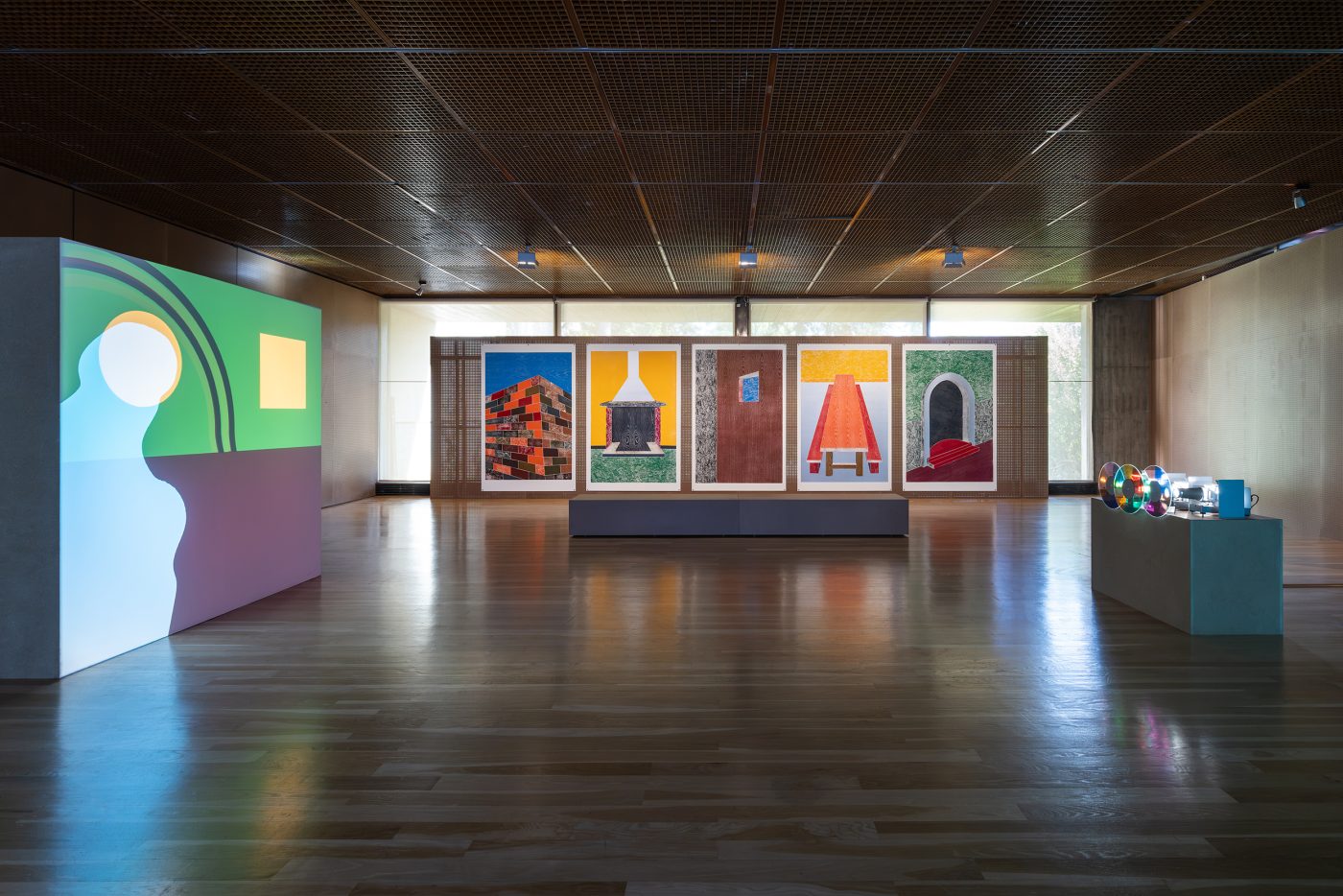
When we take a closer look at the works in Guillermo Mora’s series SÍ PERO NO [YES BUT NO], that gesture becomes literally palpable. The surviving scraps of paper not torn off by Mora, held in place by the staples that anchor them to the wall, attest to the fact that “the artist” was actually there. By examining the torn edges, as if we were forensic archaeologists, we can play at reconstructing the sequence of the rips and even try to guess which, in this case, was the final gesture that completed the piece.
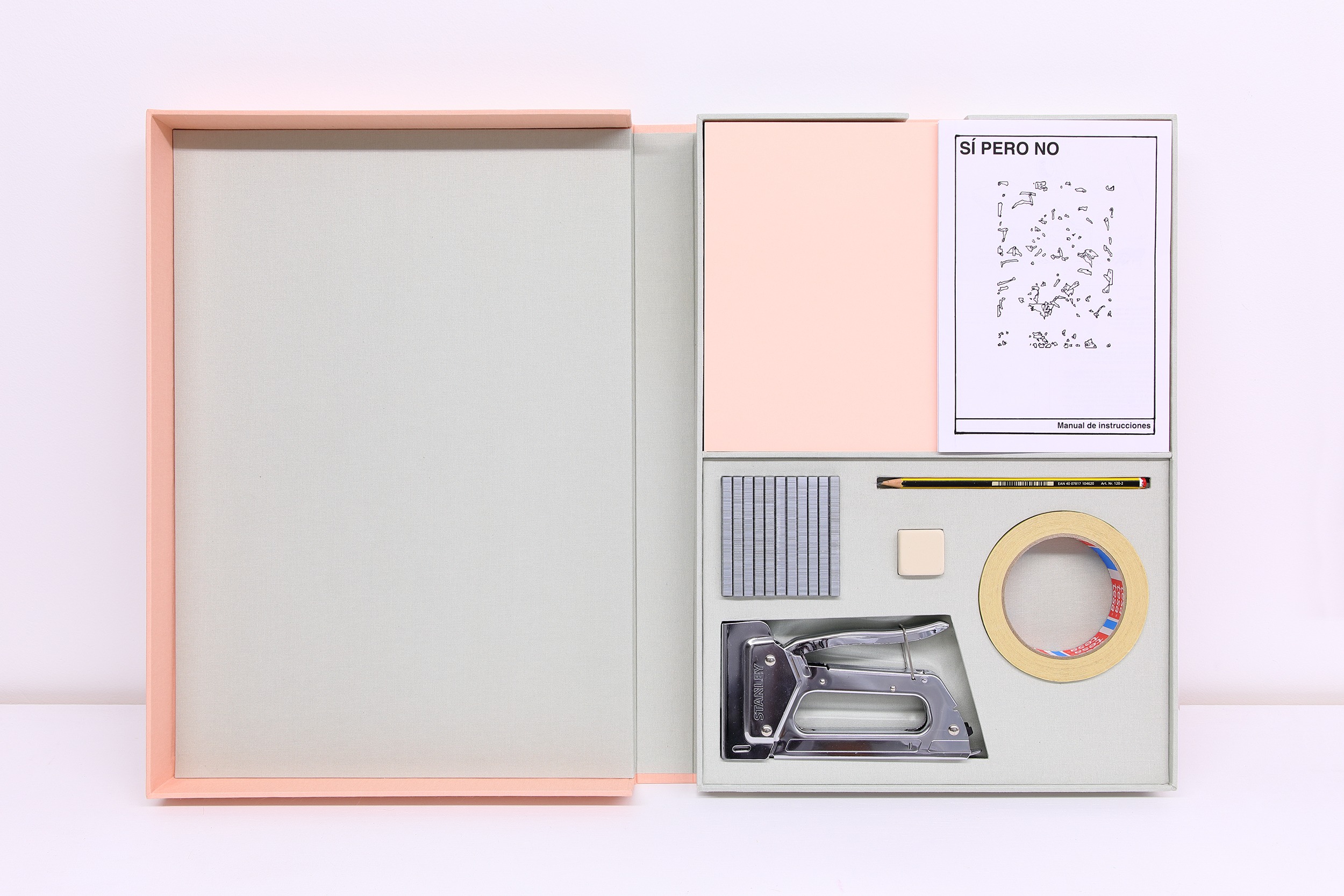
Although the effect of the gesture is more present than ever here, Guillermo Mora has managed to separate its solemnity from the idea of authorship. SÍ PERO NO is based on an IKEA-style DIY kit that comes with an instruction manual, allowing whoever acquires it to make the piece themselves. Ading to a family tree whose main branches include Fluxus and the creation of instruction pieces or event scores, Mora has made room for the painting to become a choreography that requires no prior knowledge. Performance is transformed into three-dimensional painting, and painting becomes gesture.
That gesture feels familiar because it echoes many of our own daily experiences: partially tearing a poster off a wall to reveal another beneath it, peeling away a sticker to discover the writing below, stripping a coat of paint to find the remnants of the previous surface. Even though these actions involve a seemingly destructive gesture, they end up revealing something that was hidden. Similarly, in SÍ PERO NO, the gesture becomes an act of generative subtraction.
In Mora’s practice, this revelation of hidden things is part of his strategy of constructing a less hierarchical history of painting, in which the front of a canvas is not necessarily more important than the back. As the artist explained to me, “If there is no ground, there can be no surface, and their hierarchy is always questionable.” Moreover, Mora defends the value of all the materials that make up a picture, not just the canvas and paints: “If we removed the staples, every twentieth-century painting would fall to the ground.” This act of creative subtraction does away with the hallmarks that have traditionally allowed us to recognize painting as such—there are no pigments or frame, and there need not even be an artist—to make space for that which tends to go unnoticed: staples, printer paper, adhesive tape, walls, and the marks that the process itself leaves on them. What disappears is a certain way of understanding painting, not painting itself.
In removing matter, Guillermo Mora also removes some of the certainties that go with it, forcing us to ask ourselves where a work begins and ends, and how much of it can be attributed to the artist and how much to the material, the space, or even the person who executes it. In this context, the act of subtraction makes perfect sense: it is not just about taking away, but about creating the right conditions for something to appear. Like the ripped poster that reveals a glimpse of another beneath, every tear changes what we see and exposes a possible interpretation not available to us before. In SÍ PERO NO, painting is asserted not through accumulation but through a series of losses that leave a mark. The more material that is removed, the more visible the gesture becomes; at a certain point, what we are looking at ceases to be the result of an action and becomes its trace, a map of remnants, accidents, decisions, and absences.
While those Old Master paintings thrill us because they preserve the handiwork of an artist separated from us by centuries, Guillermo Mora’s pieces offer a different kind of encounter. Here, the goal is not to identify the author’s hand but to think about what happens when that hand is no longer essential. Although the gesture remains, it is now emancipated from the person traditionally entitled to perform it. The work can be torn by another body, repeated under different circumstances, modified by chance, and yet still be SÍ PERO NO. Therein may lie its essential paradox: the ability to turn disappearance into presence and subtraction into creation.